
How to Create a Recurring Comic Villain (Traits, a Template, and a Worked Example)
How to design a comic villain readers remember across episodes: the value they defend, a repeatable pressure method, a readable silhouette, real limits, and a relationship that changes, with a copyable template and a worked example.
Quick Answer
A recurring comic villain needs more than a threatening look. Give them a value they defend, something they want from the protagonist, a method they use again and again under pressure, a silhouette readers can recognize in any shot, a real limit, and a relationship with the hero that changes after every confrontation. The villain's job is to force the protagonist into choices that cost something, not simply to delay the plot.
| Key Stats | |
|---|---|
| Foundation | A value the villain defends, in conflict with the hero |
| Repeatable | One pressure method readers learn to recognize |
| Visual | A silhouette and one or two anchors that survive every shot size |
| Growth | Every encounter changes trust, fear, knowledge, or power |
Last updated:
A recurring comic villain needs more than a threatening look. Give them a value they defend, something they want from the protagonist, a method they use again and again under pressure, a silhouette readers recognize in any shot, a real limit, and a relationship with the hero that changes after every confrontation. Their job is to force the protagonist into choices that cost something, not simply to slow the plot. This guide walks through each part, gives you a template to copy, and builds a villain from scratch as an example.
Start with a value conflict, not a costume
Readers remember what a villain believes long after they forget what the villain wears. Begin with the belief, and let the design follow.
The belief that blocks the hero
Ask what your protagonist would naturally do to solve the problem, then give the villain a principle that makes that solution costly or impossible. If the hero's instinct is to tell the truth, the villain might defend a rule that punishes anyone who speaks first.
What they want from the hero
A villain who only wants to "win" is flat. A villain who wants the hero's signature, silence, loyalty, or a specific object gives every scene a concrete target and gives the hero something concrete to protect.
Why it makes sense to them
You do not have to make readers agree. You do need the villain to be right about something in their own eyes. That keeps actions consistent from one episode to the next.
Give them a repeatable pressure method
A pressure method is the way the villain makes life harder, used often enough that readers start to recognize it. It lets the villain show up in an episode without appearing in it.
Choose one lever
Rules, debt, public reputation, information, physical force, or a favor that must be repaid. One lever is easier to remember than five. A villain who always wins through paperwork feels different from one who always wins through rumor.
Show the lever early and small
Introduce the method in a low-stakes scene so the first big use feels earned. When the reader sees the debt notice slipped under a door in episode two, the same notice in episode nine carries weight.
Make them readable on the page
In a comic, the villain has to be recognizable at every distance, from a close-up to a small figure across a street. That is a design problem before it is an art problem.
Silhouette first
Sketch the villain as a solid black shape. If you can tell them from the hero and the supporting cast, the silhouette works. Posture, a distinctive coat line, or an unusual height helps more than small details.
One or two anchors
Choose a colour block and one signature detail, such as a brooch, a hat, or a way of standing. Keep it consistent. In a series, save the villain as a character with named outfits, so each scene starts from the same reference.
Villain template (copy and paste)
Villain profile
Name / role: ___
Value they defend: ___
What they want from the hero: ___
Why this makes sense to them: ___
Pressure method (one lever): rules / debt / reputation / information / force / favor
First small use of the method (episode): ___
Limit they cannot cross or fix: ___
Silhouette notes: shape, posture, height
Visual anchors: colour block ___ / signature detail ___
Voice: how they speak and what they never say
Relationship to hero now: trust ___ fear ___ debt ___ knowledge ___
Last confrontation changed: ___
Next encounter should test: ___
Worked example: a villain from scratch
The setting is an apartment-block comic in which a young tenant, Suri, is trying to keep the roof garden her neighbors built. The villain is invented for this example.
| Field | Choice |
|---|---|
| Villain | Ms. Reyes, the building's property manager |
| Value | Order: anything that is not on the form does not exist |
| Wants from hero | Suri's signature on a form that dissolves the garden association |
| Method | Paperwork: notices, deadlines, and stamped forms |
| Limit | She cannot act without a form, so she cannot skip a step even when she wants to |
| Silhouette | Tall, narrow, a long grey coat, always holding a clipboard against her chest |
| Anchors | Slate grey coat with one red stamp-coloured scarf |
Each rule gives her the same predictable story shape: a form appears, a deadline starts, Suri has to find a rule that the form did not account for. The limit is the source of comedy and reversals, because Suri can beat her by finding the missing box on the form.
Change the relationship every time
A villain who resets each episode becomes a wall. After every confrontation, ask what changed in trust, fear, knowledge, or power. In the example, after Suri uses a loophole, Ms. Reyes now knows Suri reads the fine print. Next time she hides the key clause in an appendix. The escalation comes from the relationship, not from bigger explosions. A relationship sheet is a good way to track it.
Bringing the villain into your comic
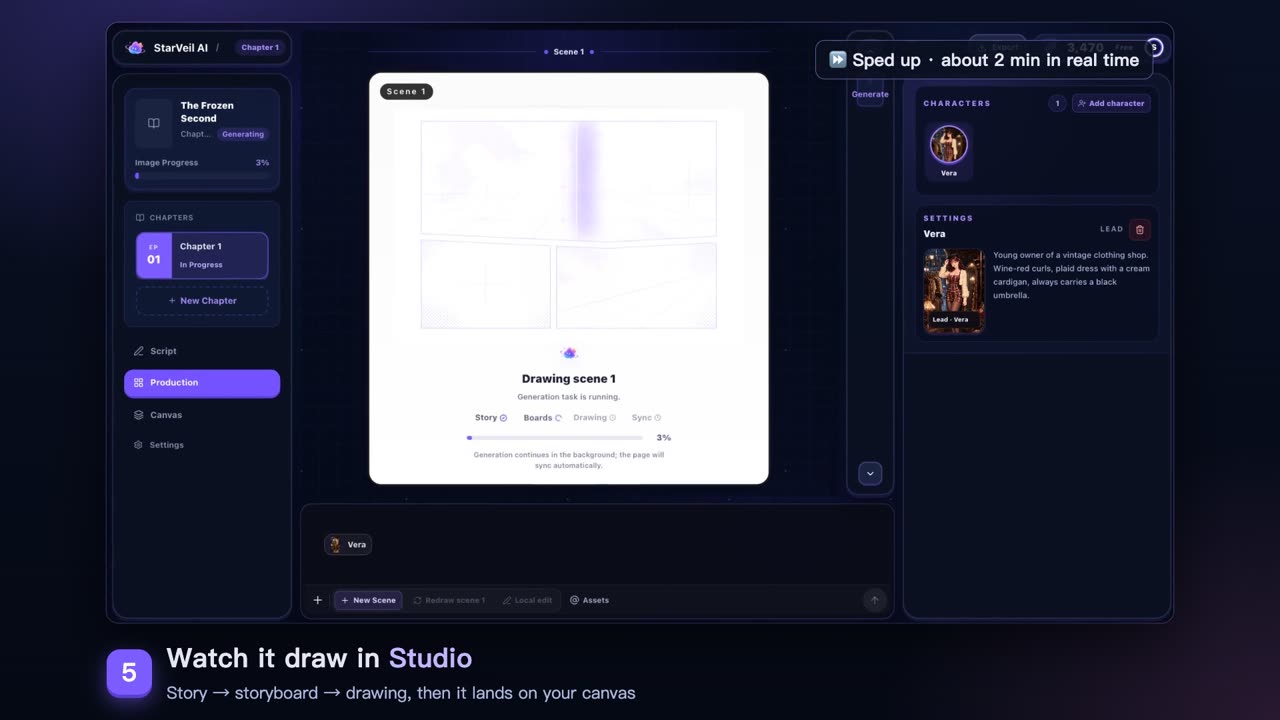
In StarVeil AI, you can create the villain once, as a character with a reference and named outfits, and cast them alongside your lead in any story. The OC maker and the AI character generator are the starting points. If you want inspiration, the fantasy character cards and the urban character cards include roles that already have a clear tone and story hooks. To see where villain-driven conflict fits inside a longer story, the webtoon story arc template maps where each confrontation belongs.