
Comic Character Relationship Sheet (Template, Examples, and a Worked Cast)
A copyable comic character relationship sheet that tracks what each pair wants, hides, and changes, with a worked three-character cast, an update rule, and how to use it while generating scenes.
Quick Answer
A comic character relationship sheet records one row per pair of characters, not one profile per person. For each pair, write what each wants from the other, what each hides, who holds the power, how they talk to each other, and the last event that changed the relationship. Update the row after any event that permanently changes trust, debt, fear, attraction, or authority. Treat it as story state that keeps moving, not a family tree.
| Key Stats | |
|---|---|
| Unit | One row per pair of characters |
| Core fields | Wants, hides, power, speech, last change |
| Update rule | After any lasting change in trust, debt, fear, attraction, or authority |
| Best for | Casts of three or more, and stories that continue |
Last updated:
A comic character relationship sheet has one row per pair of characters, not one profile per person. For every pair it records what each wants from the other, what each hides, who has the power, how they speak to each other, and the last event that changed things between them. That is what lets you direct a scene between two characters without guessing, and it keeps a long story from quietly resetting every relationship at the start of a new episode.
What a relationship sheet tracks
Most character profiles describe one person: age, job, personality, a few likes. That is useful, but a scene happens between people. The relationship sheet records the space between them, which is where the drama comes from.
Pairs, not people
Write "what Mira wants from Jun" and "what Jun wants from Mira" as two separate lines. The mismatch between them is the tension you can actually draw. If both lines say the same thing, the pair has no conflict to stage, and that is worth knowing before you write the scene.
Public and private states
Most relationships have a version everyone sees and a version only the two of them know. Track both. A pair can look like rivals in public while one of them has quietly been helping the other. Recording who knows what stops a later scene from letting a character react to something they have not learned yet.
State that changes
The last field, "last change", is the most important one and the one people skip. It is a single sentence naming the most recent event that altered the relationship. When you start the next scene, you start from that sentence, not from the first time the two met.
The relationship sheet template (copy and paste)
Make one copy of this block per pair. Keep the answers short: one line each is enough.
Relationship: [Character A] <-> [Character B]
Public relationship: what everyone sees (friends / rivals / boss and employee)
A wants from B: ___
B wants from A: ___
A hides from B: ___
B hides from A: ___
Power balance: who can hurt, help, or decide for the other, and how
How they speak: A to B = ___ / B to A = ___ (formal, teasing, clipped, warm)
Body language together: distance, eye contact, touch, who leaves first
Known by others: what third parties believe about this pair
Last change: [event] in [scene/episode] -> now ___
Next pressure: what could change this pair next
Worked example: a three-person cast
Here is a small cast for a school running-club story. The characters are invented for this example. Three people give three pairs, which is enough to show how each row differs.
| Pair | Wants and hides | Power and speech | Last change |
|---|---|---|---|
| Mira and Jun | Mira wants Jun to stop covering for her. Jun wants Mira to notice he is tired. Mira hides an injured ankle; Jun hides that he told the coach. | Equal on paper. Mira teases, Jun answers in short sentences and avoids eye contact. | Jun saw Mira limp after practice and said nothing. |
| Mira and Coach Han | Han wants Mira healthy for the regional race. Mira wants to keep her lane. Mira hides the ankle; Han hides that a younger runner is close behind her. | Han decides who runs. Mira is polite and over-prepared around him. | Han moved a younger runner into Mira's practice group. |
| Jun and Coach Han | Jun wants Han to bench Mira without saying who told him. Han wants Jun to keep reporting. Jun hides how much he is reporting. | Han has the authority. Jun is formal and quiet. | Jun's private message to Han about the ankle. |
Read across the rows and a plot appears: Jun's secret message sits inside two pairs at once. If a scene puts Jun and Mira together right after that message, the sheet tells you what each of them must not say and what their bodies would do instead.
Updating the sheet after each event
Update a row when something changes how the pair treat each other for good. Keep the old state out of future scenes once it has changed.
What counts as a lasting change
A confession, a betrayal, a rescue, a broken promise, a new debt, someone learning a secret. In the example, once Mira learns Jun told the coach, "Jun hides that he told the coach" stops being true. Rewrite the row that day, and the following scenes start from the new state.
What to leave out
A quarrel that is over by the next scene does not need a new "last change". Keep the sheet for shifts that a reader would notice if they were ignored. If you record every mood, the sheet becomes a diary nobody reads.
Using the sheet while you make the comic
Direction for a scene comes from two documents: the visual reference for how the characters look, and the relationship row for how they behave. In StarVeil AI, you save each character once, with their identity and outfits, and then bring them into a story. The OC maker and the AI character generator are the places to build that cast, and the school character cards are a quick way to try the workflow with ready-made characters.
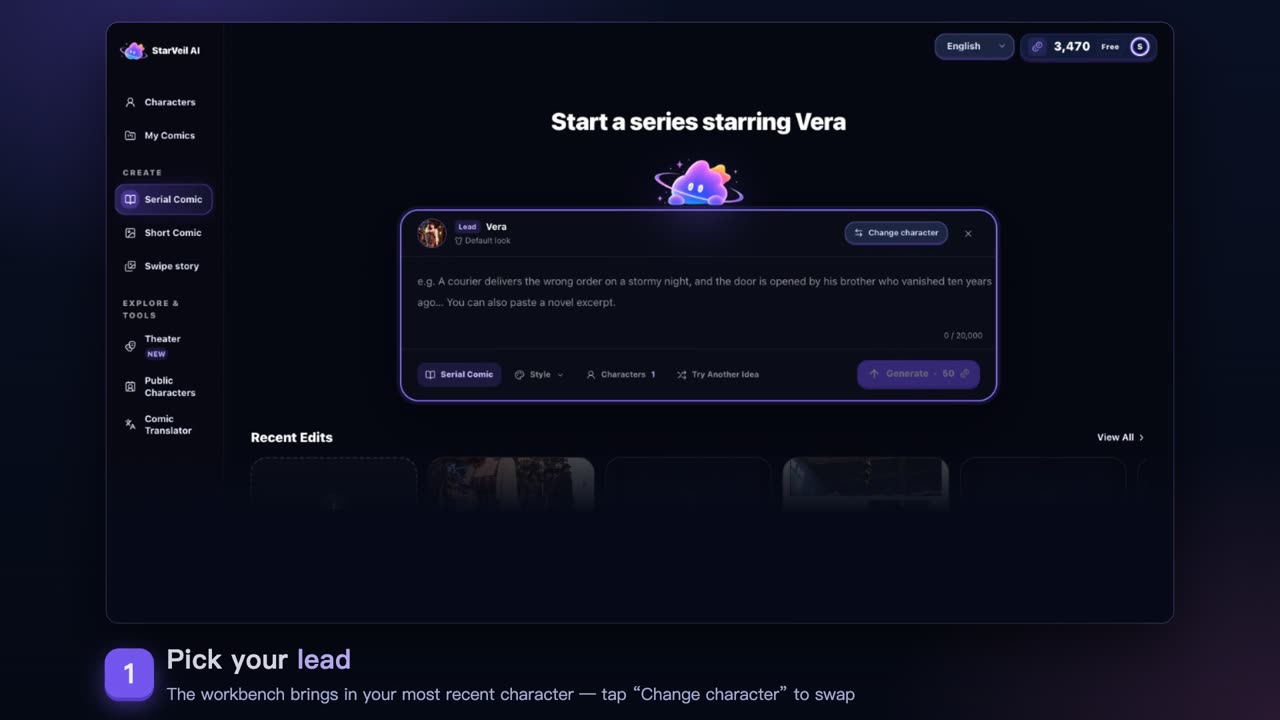
When you write the story direction, paste the relevant relationship lines into it: for example, "Jun avoids Mira's eyes because he told the coach about her ankle, and Mira does not know." Then the scene has a reason to look the way it does. If you are planning a story that continues, the AI webtoon maker builds it scene by scene, and character to comic AI covers moving a saved character across stories.