
Comic Scene Continuity Checklist (Template, Common Errors, and a Worked Example)
A copyable continuity checklist for comics and AI-generated scenes: what to freeze from the previous image, the errors that break continuity, a before-and-after worked example, and a review routine.
Quick Answer
Before you write or generate the next comic scene, freeze the state at the end of the previous image: the time and place, who is present and where they stand, what each person is wearing, the important props and where they are, any injury or damage, the light direction, and the story facts the characters now know. Continue from that state. Continuity means carrying consequences forward, not just repeating a description of how characters look.
| Key Stats | |
|---|---|
| Freeze first | Time, place, positions, outfits, props, damage, light |
| Story state | What each character now knows and what is unresolved |
| Two kinds of error | Visual drift and broken cause and effect |
| Review point | Before adding a scene that depends on the previous one |
Last updated:
Before you write or generate the next comic scene, freeze what was true at the end of the previous image: the time and place, who is present and where they stand, what they wear and carry, any injury or damage, the direction of the light, and what each character now knows. Then start the next scene from that state. Continuity is about carrying consequences forward, not only repeating how a character looks. Below is a checklist you can copy, the errors that break continuity most often, and a worked example of fixing one.
What continuity really covers
Readers notice continuity when it fails. A coat that is red in one panel and grey in the next is easy to spot, but so is a character who forgets a secret they just learned. There are two layers, and each needs its own check.
Visual continuity
Faces, hair, outfits, props, and locations. This is the layer most people think of first. It is also the one saved character references help with, because a saved reference gives every scene the same starting point for a face and an outfit.
Story continuity
Facts and consequences. If a character lost a key, broke a promise, or was told a secret, later scenes have to show that. No amount of visual similarity repairs a scene where the story has quietly reset.
Identity versus current look
Keep the permanent parts (face, body, distinguishing marks) separate from the current state (outfit, dirt, bandages, accessories). Permanent parts change rarely. The current state changes with the story and needs to be updated in your notes when it does.
The scene continuity checklist (copy and paste)
Fill this in from the last image of the previous scene, not from memory of the script.
Scene continuity check
Previous image: ___ (last visible action: ___)
[ ] Time of day and weather: ___
[ ] Location and where the camera left off: ___
[ ] Who is present, and where each person stands or sits: ___
[ ] Outfit for each character (name the look): ___
[ ] Props: who holds what, where each object is: ___
[ ] Injuries, dirt, damage, wet or torn clothes: ___
[ ] Light direction and colour of the scene: ___
[ ] What each character now knows that they did not before: ___
[ ] Unresolved action or question carried into this scene: ___
[ ] Intentional changes in THIS scene (new outfit, lost item): ___
The errors that break continuity most often
Almost every continuity problem falls into a small number of patterns. This table pairs each with a quick fix.
| Error | What it looks like | Quick fix |
|---|---|---|
| Outfit drift | A character wears a different jacket with no time skip | Name the look in your notes and reuse that name every scene |
| Prop teleport | A bag is on a chair in one image and on a shoulder in the next | Write down who holds each important prop at the end of every scene |
| Forgotten damage | A scraped knee disappears the next morning | Add injuries to the state list and keep them until the story heals them |
| Knowledge leak | A character reacts to a secret they have not learned | Track what each person knows in the story-state line |
| Light and time mismatch | Golden hour in one image, midday shadows in the next, with no time skip | Record time of day and light direction for each scene |
| Regenerated in isolation | One image is redrawn and no longer matches the scenes around it | Compare the new version to the images before and after it |
Worked example: fixing a broken continuation
Suppose scene four ends with a courier, Ana, dropping a parcel in the rain and cutting her hand on a broken window. Here is a continuation direction before and after using the checklist.
Before
"Ana enters the shop and talks to the owner." This gives no time, no injury, and no parcel. The likely result is a dry, uninjured Ana with a full bag, as if scene four had not happened.
After
"Ten minutes later, still raining. Ana pushes open the shop door, soaked, her left hand wrapped in a torn scrap of her jacket sleeve. The damaged parcel is under her right arm. The owner has not yet seen the parcel. Ana still does not know the label was swapped." Every line comes from the frozen state: the time, the weather, the injury, the prop, and what each person knows. The scene now has real consequences to play.
A review routine before you continue
Do a short pass every time you finish a scene, before you build the next one on top of it. Put the new image next to the previous one and read down the checklist. If the fix is small, such as one wrong prop, correct it now. A mistake that has a scene stacked on it is much harder to repair later.
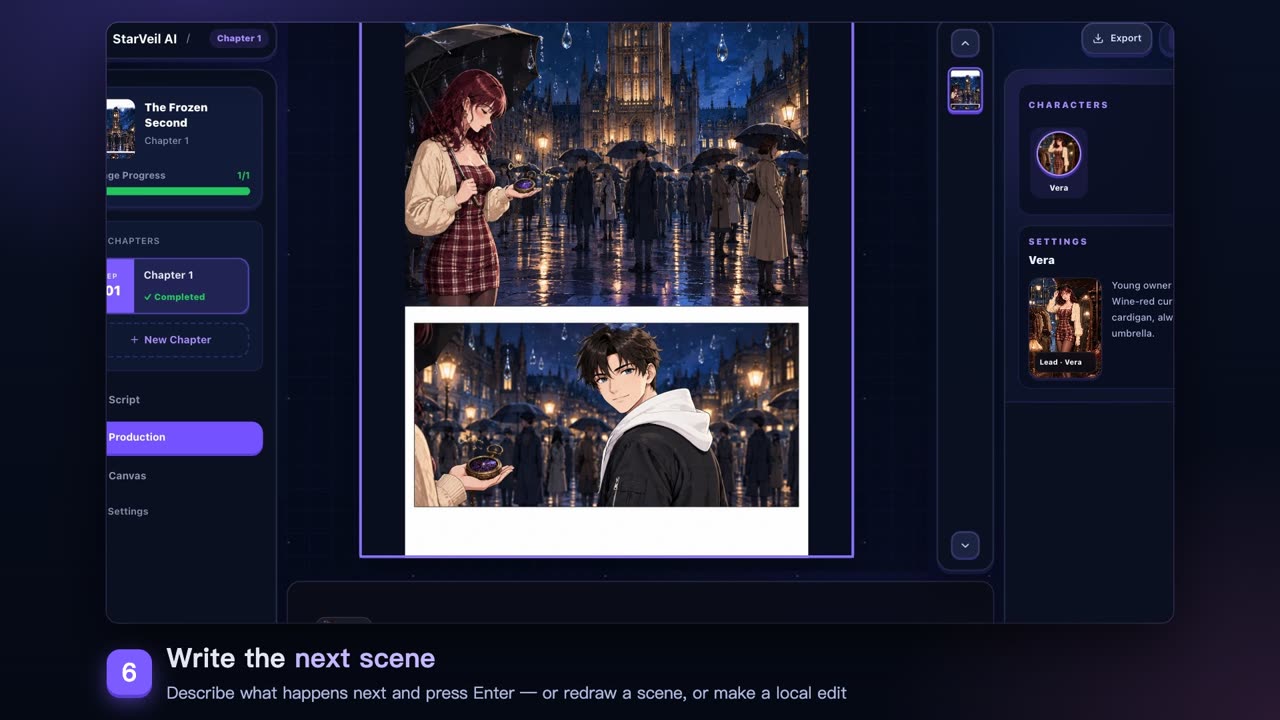
In StarVeil AI, a Series continues scene by scene from what was actually generated, and you can redraw a scene or make a local edit before moving on. That makes a natural checkpoint for this list. If you are still choosing a format, the AI webtoon maker and the AI comic generator explain the options, and the guide to AI character consistency covers keeping faces and outfits stable across a run. Working with a saved cast makes this easier: the character card library has ready-made characters you can use to practice.