Keeping memories people don't want to lose
In the official profile, Rui Ke safeguards precious memory fragments in a future where memories can be digitised and stored, acting almost as a gatekeeper.
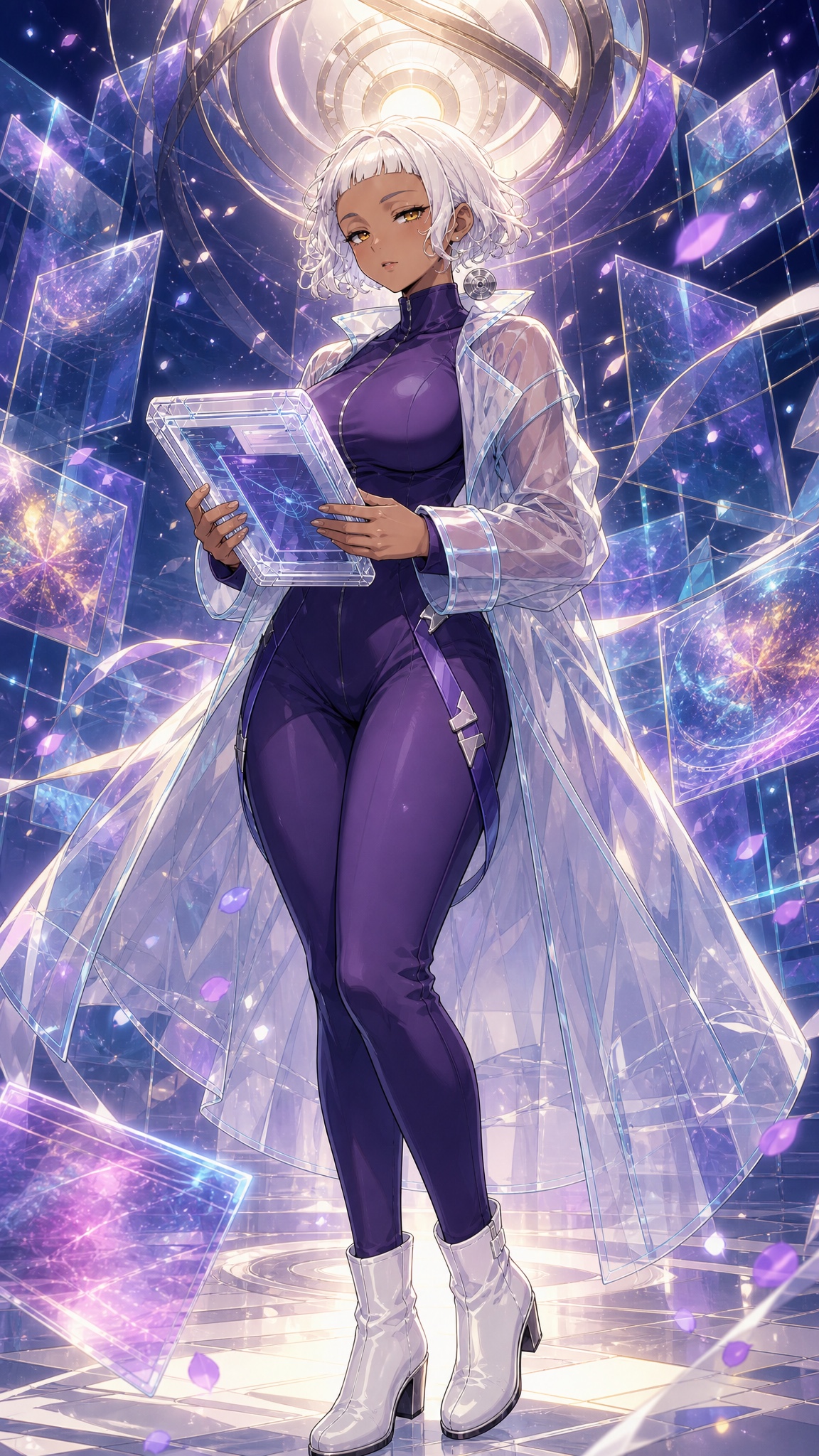
Short curly white hair with straight bangs, golden eyes, darker skin and a quiet, focused expression. Round metal earrings hang at the ears, and both hands hold a transparent archive tablet.
A deep purple high-necked bodysuit under an ankle-length transparent coat whose edges shimmer with faint iridescence, finished with white heeled ankle boots.
A circular memory archive. Tiers of golden rings and light rise overhead, square transparent screens float all around, each glinting with nebula-like light, and violet flakes of light drift through the air.
In the official profile, Rui Ke safeguards precious memory fragments in a future where memories can be digitised and stored, acting almost as a gatekeeper.
Rui Ke holds to a strict code, knowing each archive contains someone's secrets and feelings. That principle is itself a source of dramatic tension.
Moving between memory screens means meeting one complete slice of life after another, which suits an episodic structure.
The client wants to forget something completely, but Rui Ke knows the memory is tied to the person they love most.
Whatever they offer, Rui Ke has only one answer: there is no authorisation.
A possible opening: a memory screen with no registered name appears in the archive, and Rui Ke notices it grows a little longer every day.
An elderly visitor comes to collect a memory stored for decades, and Rui Ke watches it through with them one final time.
During a routine check, Rui Ke finds a memory that has been edited, and the log shows Rui Ke's own access credentials.
Sci-fi drama about memory, identity and ethics, episodic human stories and near-future mysteries.
Short curly white hair with bangs, golden eyes, the deep purple bodysuit, the transparent long coat, white ankle boots and the clear archive tablet.
Yes, but we suggest showing only what a client has chosen to share. The rule of never opening a file without permission is central to Rui Ke, and breaking it would weaken the character.