The court's youngest judge
In the official profile, Jin Yao is the youngest judge of the Holy Court, living in a world where faith reigns supreme.
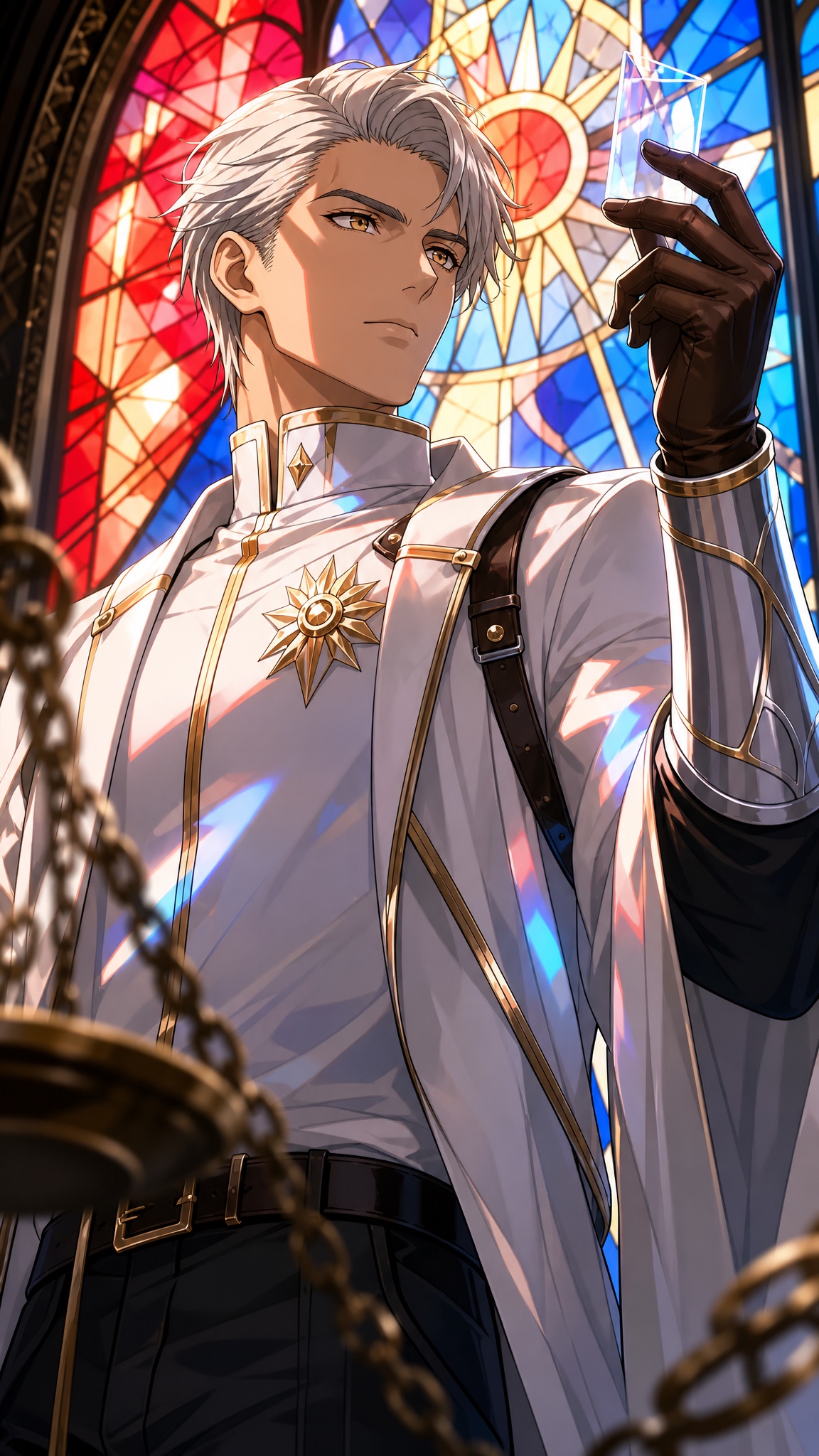
Short silver-white hair swept to one side with a few strands over the forehead, thick brows, amber eyes, darker skin and a cool, stern expression as he raises a clear crystal shard to examine it.
A long white stand-collar uniform edged in fine gold at the placket and cuffs, a golden sun emblem on the chest, a dark brown leather strap across one shoulder, dark brown leather gloves, a black belt with a gold buckle and black trousers.
Before the Holy Court's stained glass. A huge rose window of red, blue and gold radiates from a central sun behind him, coloured light falls across his white uniform, and the chains of a golden balance hang in the foreground.
In the official profile, Jin Yao is the youngest judge of the Holy Court, living in a world where faith reigns supreme.
He insists on judging only by solid evidence and never lets faith or dogma override justice, as his close study of the evidence in his hand shows.
That stance puts him in constant conflict with the court's traditional powers, and makes him the key to exposing corruption and conspiracy within.
The bishop says the gods have already given the answer, and Jin Yao replies only, "Then please hand me the evidence."
Everyone has already decided the scholar is guilty, and Jin Yao alone insists on examining the evidence first.
A possible opening: a crystal submitted as evidence records the exact opposite of the court's public verdict.
One morning, the golden balance that symbolises justice in the courtroom is found leaning to one side.
Jin Yao's very first trial ends in an acquittal, and the entire court is shaken.
Fantasy court intrigue, mysteries set around religious trials and dramas about faith and justice.
The side-swept silver-white hair, the gold-edged white stand-collar uniform, the golden sun emblem, dark brown leather gloves, the rose window and the golden balance.
The profile only says he never lets faith override justice, not that he rejects faith itself. Keeping that nuance makes him more rounded.