
Visual Story Card Template (4–6 Cards, a Worked Example, and Common Mistakes)
A copyable card-by-card template for a 4–6 card visual story, a worked five-card example, how many cards to use, and the mistakes that make swipeable stories feel flat.
Quick Answer
A visual story is a set of single scenes you swipe through, and each card should hold one scene and one change. Use card one for the hook, the middle cards for escalation or a relationship turn, and the last card for the consequence or a finished emotional beat. Every card must make sense on its own while adding something new to the shared story. Four to six cards is the sweet spot for a short idea; add cards only when a step would otherwise feel abrupt.
| Key Stats | |
|---|---|
| Card unit | One scene and one change |
| Length | 4–6 cards for a short idea (the format allows 4–12) |
| Order | Hook, escalation, turn, consequence |
| Test | Each card is readable alone and adds new information |
Last updated:
A visual story is a set of single scenes you swipe through, and each card should hold one scene and one change. Use card one for the hook, the middle cards for escalation or a relationship turn, and the last card for the consequence or a finished emotional beat. Every card should make sense alone while adding something new to the story. Four to six cards is the right size for a short idea. This guide gives you a card-by-card template, a worked five-card example, and the mistakes that most often make swipeable stories feel flat.
What a story card is (and is not)
A card is one complete image. Because the reader swipes and sees one card at a time, a card cannot rely on the panel next to it to explain what is happening. That constraint is a strength: it forces each moment to be clear.
One scene, one change
If a card holds two events, the reader will only register one of them. Pick the single thing that happens on that card, such as "she opens the door", "he sees the note", or "they laugh". If you cannot name it in a few words, the card is doing too much.
Readable alone
Show the card to someone without the rest of the story. They should be able to say who is in it, where they are, and what just happened. Dialogue and short text belong on the card when the image cannot carry the fact.
Shared story
Even though each card stands alone, the cards must add up. Each one should give the reader something new: a fact, a choice, a shift in the relationship.
The 4–6 card template (copy and paste)
Fill in one line per card, then check that no two cards have the same job.
Visual story card plan
Idea in one sentence: ___
Cast (up to 3): ___   Setting: ___

Card 1 - HOOK: the situation that makes the reader ask "what happens?"
Card 2 - PRESSURE: the first obstacle, reaction, or discovery
Card 3 - TURN: a choice or a shift in the relationship
Card 4 - CONSEQUENCE: what the choice costs or changes
(Optional) Card 5 - BRIDGE: only if the step from 4 to the end feels abrupt
Final card - PAYOFF: answers the promise made on card 1

Check: every card adds new information / no card repeats a mood /
the last card answers the first.
Worked example: a five-card story
The idea: a shy florist has been leaving one flower on a stranger's doorstep every morning, and finally has to explain herself. The characters are invented for this example.
| Card | Job | What we see |
|---|---|---|
| 1 | Hook | Dawn. Nori puts a single white flower on a door and hurries away. Beside the door are seven dried flowers in a jar. |
| 2 | Pressure | The door opens early. A man in slippers holds a full jar of dried flowers and looks up the empty street. |
| 3 | Turn | Next morning Nori hides across the road. The man sits on his step, waiting, with a second cup of tea beside him. |
| 4 | Consequence | Caught, Nori freezes. He hands her the cup and says nothing. She sits next to him, and the empty jar is between them. |
| 5 | Payoff | Weeks later. The jar now holds flowers from both of them, and a small handwritten sign hangs from the door: "Fresh flowers, open." |
Each card has one change: a flower, a door, a wait, a shared cup, a sign. Together they answer the question card one asked: why is she doing this, and what does he do about it?
How many cards do you need?
Start with the smallest number that keeps cause and effect clear. Four cards work for a clean gag or a small emotional beat. Five or six work when the story needs a turn before the payoff. If you keep wanting more cards to explain each step, the story may need a longer format.
When four is enough
One question, one obstacle, one choice, one answer. Many comic jokes and short emotional moments fit this shape.
When to add a fifth or sixth
Add a bridge card when a leap would confuse the reader, such as a change of place or time. Do not add one just to repeat a mood.
When to switch format
If the story needs many locations or keeps producing consequences that need their own scenes, plan it as a series. The guide to short comic, visual story, and series helps you compare the three.
Common mistakes
- The background card. Opening on explanation. Start on the situation.
- The repeated card. Two cards with the same mood and no new fact. Merge them or change the second.
- The unreadable card. A moment that only makes sense if you have seen the previous card. Add a visible cue.
- The unanswered ending. The last card introduces a new question instead of answering the first.
- The character who changes. The cast looks slightly different on each card. Use saved references and name each outfit.
Making it in StarVeil AI
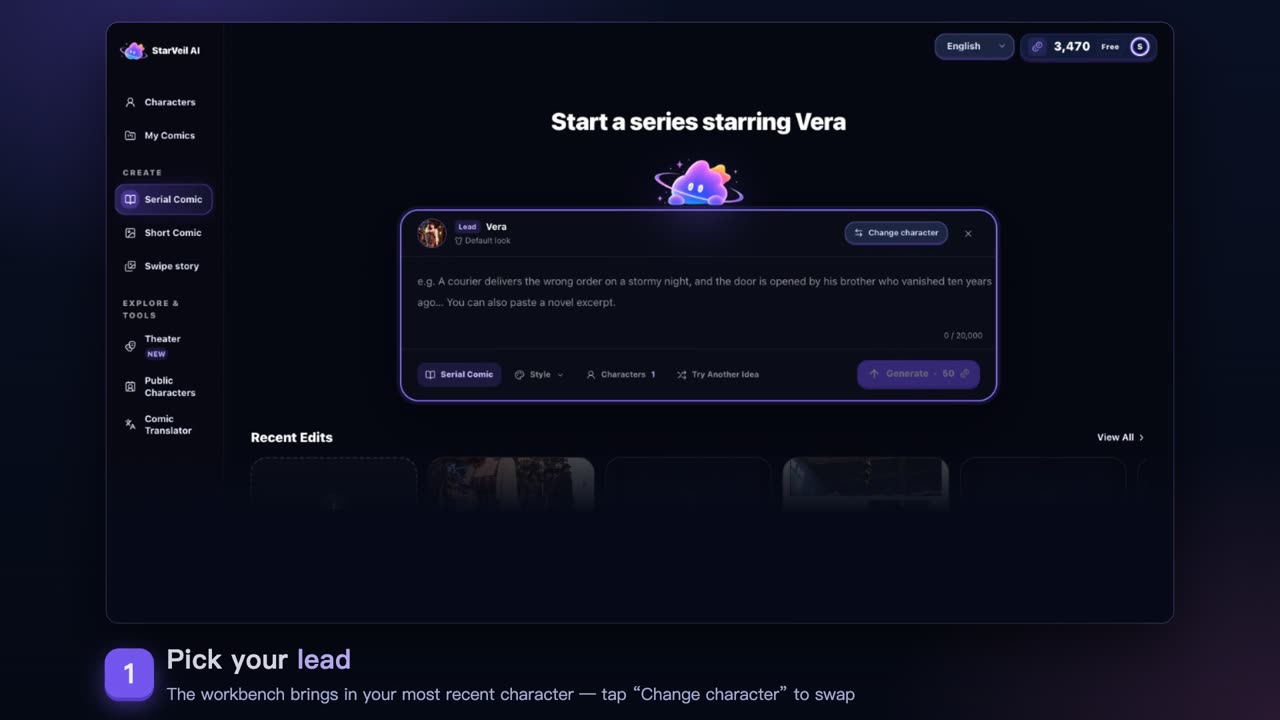
In StarVeil AI, the Swipe story format is the visual story: you describe the idea, choose up to three characters and their looks, and confirm before it generates. A saved character keeps the same face and outfit across cards. You can build a character in the OC maker or start from a ready-made character card, such as one of the romance characters. If you would rather start from an existing story shape, the comic templates and the healing comic templates show finished structures you can remix with your own character.