
How to Adapt a Short Story Into a Comic (Steps, a Worked Example, and Which Format to Pick)
A step-by-step method for turning a short story into a comic: find the visual spine, convert prose into images, protect cause and effect, choose the right format, with a copyable worksheet and a worked example.
Quick Answer
To adapt a short story into a comic, find the visual spine first: the opening image, the central visible conflict, the smallest cast that can carry it, the turning point, and the ending consequence. Convert description into setting, action, expression, and props. Cut narration down to captions the image cannot carry. Keep the chain of cause and effect intact even when you cut scenes. Then pick the smallest format that fits: one change suits a short comic, four to six moments suit a visual story, and consequences that keep growing suit a series.
| Key Stats | |
|---|---|
| Start with | The visual spine: image, conflict, turn, consequence |
| Convert | Prose description into setting, action, expression, and props |
| Protect | The chain of cause and effect, not every scene |
| Format | Short comic, visual story, or series by the number of necessary changes |
Last updated:
To adapt a short story into a comic, find its visual spine first: the opening image, the central visible conflict, the smallest cast that can carry it, the turning point, and the ending consequence. Then turn description into setting, action, expression, and props, cut narration to the captions an image cannot carry, keep the chain of cause and effect intact, and pick the smallest format that fits. This guide walks through each step, gives you a worksheet to copy, and adapts a 200-word story as a worked example.
Find the visual spine
A short story usually has one thing that must survive the adaptation. Everything else either supports it or gets in its way. The visual spine is your short list of that essential material.
The five pieces
Write the opening image, the conflict you can actually see, the characters you cannot lose, the moment the situation turns, and the consequence at the end. If any of these is hard to name, the story may rely on inner thought, which is harder to show.
What a spine leaves out
Backstory, a narrator's opinions, and events that do not change what happens at the end. You may miss some of them, but readers will not.
The adaptation worksheet (copy and paste)
Short story to comic worksheet
Story in one sentence: ___
Opening image (what we see first): ___
Central visible conflict: ___
Minimum cast (who cannot be cut): ___
Turning point (the moment it changes): ___
Ending consequence (what is different at the end): ___

Prose to image
Line I need to convey: ___  ->  show it with: setting / action / expression / prop
Fact the image cannot carry: ___  ->  caption or line of dialogue

Cause and effect
Choice that causes the ending: ___
Scenes I can cut without breaking that chain: ___

Format
Number of separate changes needed: ___
Short comic (1) / visual story (4-6) / series (many): ___
Worked example: a 200-word story in four steps
The story, invented for this example: A lighthouse keeper, Oda, has kept a lamp lit for thirty years for a ship that never came back. One night a small boat arrives carrying a girl who says her grandfather told her to look for the light. Oda realises the boy who left is the girl's grandfather and that he lived. She turns the lamp off for the first time and walks the girl home.
Step 1: the spine
| Piece | Choice |
|---|---|
| Opening image | A tiny lit lighthouse on a dark coast, one figure in the window |
| Conflict | Oda keeps the lamp burning for a ship that will not return |
| Cast | Oda and the girl. The grandfather appears only in dialogue |
| Turning point | The girl says who sent her |
| Consequence | Oda switches off the lamp and leaves with the girl |
Step 2: convert prose to evidence
"Thirty years" cannot be seen. Show it: a wall of dated log books, a worn spot on the step where she always stands. "Oda realises" is a thought; show it with a close-up on her hand hovering over the switch. Keep a caption only for "Thirty years earlier". The image cannot state that fact.
Step 3: protect cause and effect
Cut the long backstory of the boy leaving. Keep the girl's line, because it causes the ending. If you removed the line, Oda would have no reason to turn off the lamp, and the ending would feel arbitrary.
Step 4: choose the format
The story has one central change: the lamp goes out. That fits a short comic. If you want to show the sea, the arrival, the dialogue, and the walk, five moments fit a visual story. If the walk home opens a bigger story, it becomes the first episode of a series.
Common adaptation mistakes
- Filming the prose. Trying to show every sentence. Choose the sentences that move the story.
- Caption overload. Repeating in text what the image already shows.
- Losing the cause. Cutting the scene that makes the ending happen.
- Too many characters. Keeping secondary characters who do not touch the turning point.
- The wrong format. Forcing a story with many changes into one image, or stretching a small one across twenty scenes.
Making the adaptation in StarVeil AI
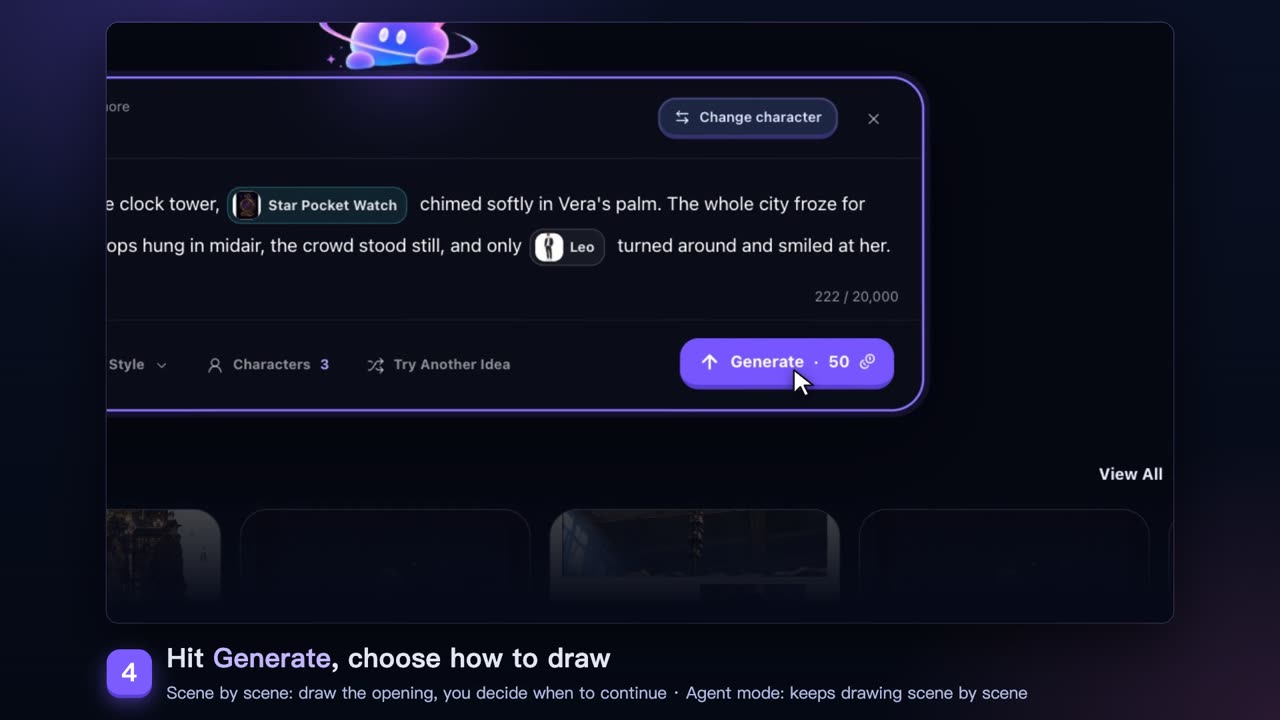
In StarVeil AI, you can paste your source text and choose Short Comic, Swipe story, or a Serial Comic. Mention the characters you want inside the text so the same faces carry through. If you do not have characters yet, the OC maker creates them, and the character card library has ready-made ones. For a longer source, novel to comic AI and the novel to manga workflow explain the longer path, and the AI comic generator shows how story text becomes connected panels.